Showing posts with label Rape. Show all posts

Tuesday, 11 August 2015

My Latest Snuggle Buddy


I'm madly in love, I tell you. After months of aridity - more months than I care to count - I'm finally getting it again. Coffee that is. I finally got a new coffee maker, and the coffee to go in it, and I'm thrilled to death to be able to report that I had my first cup today. Wow, yum. That's all I can say. It's the perfect little doodad for me, too. Just look at the picture and you'll see what I mean. It does a cup at a time, which is all I can drink usually anyway. It came with a mug, scoop, and permanent filter. It's absolutely sublime. I'm sure the infatuation will fade eventually, but for now I will revel in newfound love.
My New Snuggle Buddy


Additionally I've had some other wonderful things happen lately, and maybe a not-so-wonderful wake-up call, or two. For starters, I'm working on this great project. It's a video about rape prevention, protection and recovery. As usual I'm working with my friend and business partner, +Steve Kovacs, who is really pushing this project. It says wonderful things about him that he feels this is so important. It's a multi-prong approach to dealing with rape. Not just for women, either. It's for parents who want to teach their boys not to rape, and their girls not to engage in victim-blaming. It's for anyone who wants to physically prevent being raped using techniques from a real expert (that would be Steve, since he's a 9th Dan Black Belt in Minna Jiu-Jitsu, and the soke of that style), and it's for anyone who wants to recover from rape.

So, in the spirit of having to be on film for certain segments of this project, I knuckled under and decided it was time to do the wild and crazy things I've been putting off. Such as dyeing my hair a crazy colour, growing my nails, wearing make-up, etc. I actually had to go out and buy make-up, because mine is long past any expiration date. The one thing I should have bought, and didn't, was mascara. That's the one you have to watch for when it comes to bacteria getting into your eyes. I think I've got a fairly recent one, however, so I'll take a chance. After all, the colour I get never really changes.

I wanted to get a haircut, too, but chose a six-pack of beer after a hard day's shopping, rather than walk several blocks to the hair place. I was already worn out, and hey, The Beer Store was right there (yes, it's actually called The Beer Store here in Ontario, Canada). I hadn't had beer in so long. Sadly, six beers were only enough to get me mildly tipsy, despite the fact that I rarely drink. I have a very high tolerance for alcohol for some reason. Probably the Irish and Scottish in me.

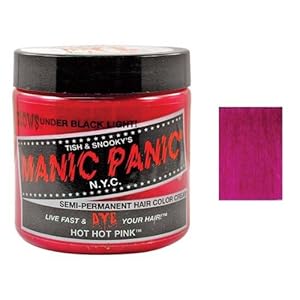
I chose Manic Panic's Hot Hot Pink for my new crazy colour. I'm not stripping it first, so it will come out sort of a raspberry colour I think, which really isn't extreme, but I'll get there eventually. I'm personally angling for bright purple, blue or green at some point, but I'll surf through all the colours at some point.

I was a little confounded and depressed by the whole make-up thing. I mean, even the regular, drug-store type stuff like Revlon is getting expensive. $17 for an ounce of a substance that's actually supposed to look invisible - also known as foundation. $70 later, and sans mascara or blush, we left the cosmetics department. Ugh. Still, it'll be fun to play dress-up.

I've finally managed to set up my shot appointment again, too, for those ultrasound-guided injections into my hips. Took weeks of calling, but I finally got bumped way ahead on the list. I already had an appointment for July 3rd, but they cancelled, so by rights they had to put me in ahead of the pack. Yesterday I saw my doctor for a physical for the first time in about 4 or 5 years, and went through the whole deal. I also got my tetanus shot, and all the bloodwork, plus a liver function test and a check on my B12 levels. I'll probably have to go back in once more to get my vial of B12, along with some needles, but if I have to go in there for the shots I'll never stay with them consistently. Other than that, assuming my results are relatively normal from the tests, I won't have to go back to my family doctor for years again, and I'm fully up-to-date on everything. Yeah, baby!

I've been put on Tylenol 3s, since I was taking far too many Tylenol 1s. This will save my liver a lot of aggravation, and hopefully I'll notice fewer issues with my blood sugar. She's also sending me for an x-ray and ultrasound on that knee I hurt in March. This was the first time a doctor has looked at it. I know, I'm terrible, but not being able to get down the stairs at the old place meant not getting to the ER when it would have made a difference. And then I procrastinated even though I knew something was still wrong with it.

There were two things from Friday and yesterday that I wasn't exactly thrilled with, but I maintain my positive attitude anyway. The first is that it looks like our 15-year-old cat has cancer, but she's still healthy and probably has a lot of life left. She goes back in a couple of weeks for a check-up and possible testing. I don't think surgery will be viable, since they would have to remove her mammary area pretty much completely, along with spaying her to get rid of the hormones. The vet said the tumours tend to come back pretty aggressively if they miss anything, though, and it's very hard to get it all. Plus she's not exactly a kitten anymore, so I'm not sure if we'll put her through surgery. We'll decide when the time comes. As I said, she's still acting completely normal, and the vet said she seems healthy and active, so we're not borrowing trouble.

The other item that wasn't great was my weight. I'm heavier than I've ever been in my life, and I can't fool myself into thinking it's muscle these days, so I need to get a lot more serious about that exercise plan I mentioned in my last post. If I average out what I've done since my birthday, I'd say I've been getting some pretty loose exercise a couple of times a week. It's not enough. I can still do sit-ups, touch my toes, and boogie to the music - I just don't look as good doing it. So, it's time to do more than a little yoga and a few sit-ups. I have to build up some muscle to start burning up my stored energy (also known as fat).

Still, things feel really good for me today. Knowing most of my issues are being taken care of, and that I've gone ahead with the plans I made for my life this year, makes me feel positive about pretty much everything. And now to celebrate, I think I'm going to snuggle up with that adorable little coffee maker again, and possibly wheedle another cup for myself. The first one went down just a little too smoothly.

Monday, 16 February 2015

Stopping the Insidious Craving for Obsessive Love, Stalking and Domestic Violence

The massive popularity of 50 Shades of Grey is more than a little bit alarming. I have nothing against a little role playing, or even BDSM if that's what you're into in the bedroom. Two consenting adults should be allowed to do whatever they want. The problem I have is when it gets romanticized as a way of life. When a man tells a woman, "I will find you," that's the sign of someone who is seriously mentally disturbed. It's not sexy - it's very, very scary.

I come from a place of personal experience here. I've been raped, I've been stalked, and I've been held against my will. It was far from being a turn-on, and there's a good reason for that. It's called self-preservation and survival. When you're in a seriously dangerous situation with someone who is unstable, it's pretty damn stupid to want to jump their bones.

So why do people get off on this kind of thing? Because it's a fantasy. Fantasy is fine, and frankly it's a whole lot of fun. Fantasy with another person can be even more fun and sexy. What it requires, however, is a very deep level of trust. So many people are paying to read 50 Shades, and then they're traipsing off to the theatre to see it. Far too many people are thinking it's just opening up people's minds to BDSM. It's not. BDSM needs to remain in the bedroom. When one person in a relationship is being subjugated constantly and it becomes a way of life, eventually that person is going to want to do something their 'master' doesn't want them to do. When that happens the reaction can be terrifying.

What we need to figure out is why this is still such a prevalent fantasy for women. If you're one of those women, it's extremely important. In fact, it can be life-and-death important. There are women in domestic violence situations who cannot break away because they've been conditioned to believe a man should have control over them. They believe that physical strength in men is to be desired, rather than mental strength. When it comes time to press charges they don't want to, no matter how badly they may have been hurt. Men are constantly forgiven for abuses against the person they're supposed to love and cherish above all others, society passing it off as a private issue.

I'm not one of those people, and I've personally boycotted any celebrities I'm aware of that have engaged in that sort of behaviour (once it's been proven, of course). I'll never pay for a Mel Gibson movie again in my life, or a Mötley Crüe CD or song as long as Tommy Lee is involved with the project. I don't care if they've gone to jail and 'paid' for their crimes. I don't think the criminal justice system takes it seriously enough, and that's especially true of celebrities with lots of money to spend on high-priced lawyers. Real men do not lay hands on women in anger. They have no need to 'prove' their control over another person. Any man who does this is inherently weak, and is looking for ways to compensate.

This is what needs to be stressed to both women and men in order to avoid tragedies in the future, such as domestic violence and murder. The perception that a man is strong because he is physically capable of pushing someone around, and that it makes him sexy when he shows how 'manly' he is, is a very big part of the problem. Truly strong people have no need to do this. If more women understood this, they would be much less impressed by physically violent men. Controlling a woman doesn't make a man strong - having no need to control anyone is the true indicator of strength. That's called self-esteem. It's only the men who feel insecure that attempt to control others, in part because they have no control over themselves or their own lives. The more insecure a person is, the more of a control-freak they usually are.

When you really stop and think about that - I mean sit down and actually concentrate on it - it's not hard to start feeling contempt toward people who behave that way, and it doesn't matter whether it's a man or woman exhibiting the behaviour. When you truly realize that only someone who feels weak will pick on others and bully them, we start to lose respect for them. We can see that they must have serious problems of their own that are triggering the behaviour, and it's less and less likely that we will allow them that control over us. It doesn't apply only to domestic violence, either.

When it comes to role-playing, there's nothing whatsoever wrong with it. As long as there's a clear delineation between reality and fantasy. Some people enjoy subjugation, but when you take a mental trip and imagine your entire life spent in bending to the will of another, how many people truly want that as a part of their lives? What happens when you come home from a job you love, and your partner tells you that you have to quit so you can serve them? What happens when you're not allowed to see friends and family members that you love? What happens when you start having to explain the bruises to other people? Are you going to start lying and covering up? If your response to a query is simply a smirk and a fond memory of the night before, that's fine. If your response is along the lines of fearing what will happen if others find out, maybe you need to do some serious thinking about where you want your relationship to go, or if you want it going anywhere.

Wednesday, 26 November 2014

Why Victims Don't Leave - The Domestic Violence Stages

As my readers are aware, I'm the executive producer for The Kovacs Perspective. Regular readers will also be aware that I've had some experience with domestic violence, which is the topic for tonight's episode. What many people may not realize is what actually occurs in a domestic violence situation and household. If it has never happened to you, or you're in denial about your personal experiences, you may not have any idea what constitutes domestic violence. Well, here's what I know, based on my own experiences, as well as through the many hours of research that I've done in order to write about the topic from varying perspectives:
In any situation where your partner controls you in any way, you are being subjected to abuse.
Do not dismiss this notion, because at its core this is the absolute truth. We are all, every one of us, unique individuals who have the right to control every aspect of our selves. Why do I phrase it like that? What does that mean exactly? Answering those questions means jumping right into the initial stages of the abuse cycle.

Abuse begins slowly, and it begins in the most innocent-seeming ways. First it starts with suggestions about little things that you do. Maybe your partner doesn't like the way you wear your hair, or whether or not you wear make-up (along with how much you wear). Maybe they start picking on pieces of your personality, like how much you talk when their friends are around, or the things you might say. Maybe they start acting embarrassed when they're out with you, shaming you into changing small things about yourself, pushing you into the background of your own life choices.

You see, that's where the control starts. The first thing an abuser does, even if they're not doing it consciously, is convince you that you no longer own your own life. They convince you that they're the ones who should have a say, not you. There's no discussion, really. They just tell you, "I don't like your hair like that." Suddenly you're growing it out, dyeing it, or getting it cut. They say things like, "You should wear skirts more often," "You should get a toupee," "I don't like goatees," or "You look like a tramp wearing that much make-up." They make you feel bad about the decisions you made that day. They undermine your authority over yourself. The implied message is that they can fix you, that you're not good enough the way you are, and that in order to deserve their love you have to change.

Those changes don't seem like much. At first. Then the changes become more difficult to adhere to - after all, the new behaviour isn't your natural persona so you're suddenly putting on an act in front of everyone. Your new life is a mask, covering up the real you. However, in order to please your partner you submit to their wishes. Everyone wants to be attractive to the person they love, but what they don't realize is, if that person was really the right one for you, then they would be attracted to the real you. They would love that person, not the one they're trying to mold you into.

The more difficult changes that come can be anything from the type of job you have (especially if they feel threatened because you make more money, or maybe you don't make enough money), to the people in your life. Your friends and family are a threat to this person, because they know those people are important enough to you that you might actually listen to them over your partner. They get scared that one of them will tell you to leave. Isolation is the goal here, and it may not even be a conscious connection that the abuser is making. It would be hard to find out, even by asking hundreds of abusers, because they have a tendency to deny or justify their actions even to themselves.

So how do they get rid of your friends and family? Simple. They just make it easier for you to not see them. How? Imagine this: Every time you see your friend or family member you get into a fight with your partner. It doesn't even have to be a fight about that person. It can just be an associated feeling for you. You start to feel nervous every time you come home from being out with anyone who isn't your partner. You know, deep down inside, that there's going to be an argument the minute you close the front door behind you.

Sometimes it's more direct. There can be accusations about what you might be doing with those people, and there may not be any logic whatsoever to those accusations. Maybe the accusation are sick and twisted, like they accuse you of 'something funny' in your relationship with a family member. Maybe your partner believes what they're saying, and maybe they're just saying it to put you on the defensive. It's just as effective either way. You're defending yourself, which automatically puts you on the weak side of the argument.

So, you find yourself going out less and less often. Your phone conversations get shorter. It's just easier that way. You're trying to avoid the fights. It's still not enough, though. Your partner's insecurity is constantly lashing you. Criticisms spewed at you so that your partner can feel superior to you, and so they regain control. Without that control they're sure that you're not going to stay. That's not always the case, of course. Some abusers simply enjoy hurting other people, and that's because they're sadists. Those ones don't fear you leaving, but often they fear other people finding out their little secrets, and your leaving would mean you've gotten the upper hand with them. That's something a sadist will not allow. That behaviour may be rooted in insecurity at its core, but even insecurity has been bypassed by what is often sexual excitement.

There may be a great deal of time between these levels or stages of a person asserting their control. If there's a month between a criticism of your hair and a comment about your clothing, it's not going to seem all that controlling. It will seem like a suggestion at first, but then when you keep doing what they don't like they will express disappointment at the very least, and you will feel like you should be trying to please your partner. They will make it seem as though you're being petty and selfish, or you're unwilling to compromise for the sake of the relationship. Now it's suddenly your fault that the two of you can't get along. That blame will become a big part of your future, turning into statements like, "It's your own fault for pissing me off." Not only do they not realize they shouldn't even be asking you to change, but also that their response to their own emotions is not under your control in any way.

This is probably where I was lucky when it comes to my personal situation. Despite having a very rough childhood, or maybe because of it, I learned to take responsibility for my own actions. I've seen many cases where the opposite was true, however, and people blamed their actions on their childhood of abuse, never getting to the point where they said to themselves, "I'm now in control of my life, and from here on out I have a choice." So, when someone tries to tell me that their behaviour is my fault, I don't buy it. I can understand an eye for an eye, so if I had punched someone in the face I would expect someone to punch me back. However, if I haven't done that to a person, they have no business doing it to me.

People who remain in abusive situations, however,  have been subjected to behavioural conditioning. Much like Pavlov's dogs, they will react predictably to certain stimuli. In the case of the dogs they would start drooling at the sound of a bell. In the case of abuse victims they will start to feel debilitating fear at whatever they've learned as the signs of abuse to come. It could be a certain look, a phrase, or even their own actions that they know their abuser has reacted to in the past. It's not their fault or their responsibility to avoid abuse, however - no more than it's the responsibility of a rape victim to avoid being raped. It's the person committing the violence who is responsible.

It doesn't even have to be physical abuse, but verbal abuse is much more difficult to pin down and define - especially when it comes to a courtroom. Verbal abuse is grounds for divorce in many places, but courts have a hard time making consistent decisions about what really constitutes abuse. The second someone makes unwanted physical contact, that's a line that's been crossed that everyone is capable of seeing. Admittedly that line moves all over the place, because even courtrooms don't always recognize spousal rape. Small things like grabbing a partner's arm and pulling them where you want them to be - that's controlling, and it's abuse, because you're physically forcing someone to do something they're not willing to do on their own, and we simply haven't the right. We each own our own bodies. They belong to us and no one else. All decisions about that body should be coming from our own minds.

Of course, when the government clamps down and tells individuals what they can and can't do, for whatever arbitrary reason, it becomes a lot more difficult to recognize abuse in domestic situations. Rape goes unpunished, even when it's a teacher raping a student. Autonomy is undervalued in most societies. People are told they have no choices by the very governments and courtrooms that are supposed to be there to protect them. When it comes time for someone to stand up against an abusive partner, there's no fundamental legal support, despite the numerous laws that have been written. If the laws aren't enforced, abuse victims are left to fend for themselves. If they stand up and defend themselves against their abusers, however, they're often severely punished by lengthy prison terms.

Believe it or not, all of this is just the lead-up to the main event. An event which becomes the everyday life of the victim. We haven't really touched on the first time a person is hit, or their arm is twisted so hard that it breaks. We haven't even gotten to the part where their self-worth is completely stripped, so let's go over that. All human beings are susceptible to behavioural conditioning on some level, and that conditioning is what enables abuser to maintain control over their partner. The conditioning may be done gently or viciously, depending on what the victim responds to best. In most cases it's fear-based.

It may start out sounding like a joke, even. They might smile when they tell you, "If you ever left me, I'd have to kill you." Maybe something more subtle than that like, "I'll never let you go," or "I'd kill myself if you ever left me." How many people in this world would be flattered by that? How many people are flattered by jealousy in their partner? Even those who outwardly deny feeling flattered often feel all tingly inside at the idea that someone 'loves' them so much they can't live without them. The very things that may seem so loving and needy to a person seeking the love of their life, however, can be extremely dangerous. The healthy way to say those things would be more like, "I'd hate to lose you," or "As long as you want to be with me, I'll never let you go." Both of those things imply knowledge and awareness of the other person's right to choose.

Statements that imply the end of someone's life should the relationship end are a really big warning sign. "Until death do us part," a part of most wedding vows, becomes a lot more sinister in that context. In some cases there's a religious element, too, where a partner is controlled by their beliefs. That's true in Catholicism, certainly, where excommunication is an issue. Most people can't afford the $5,000 they can charge for an annulment. If you're an abused partner, hoping for support from your church, you may be correct in assuming that they will not help you leave your spouse.

Then there is the actual, hands-on, abuse. In many cases the first physical abuse may seem unintentional. For that matter it might well be an accident, but it can become a gateway to more intentional abuse. They might make it seem as though it was an accident, too. Victims of abuse aren't always sure they've been intentionally hurt by their partners. People brush off hurts and insults all the time in their daily lives. We have to in order to function in society. You can't react to every little thing, or people would be shooting each other more than they already are. Brushing things off becomes habitual, and quite often we're not sure when enough is really enough. For people who hate confrontation, the decision is even more painful, and people will question themselves and justify the behaviour of other people just to avoid that confrontation.

If you already fear a person's reaction, and are reacting to it yourself, you're being controlled by that other person's behaviour. Yes, you're choosing to let them, but it's usually because one thing is the lesser of two evils. When you have small children whose lives may be threatened by someone, you have no job, no driver's licence, no car, no friends and no family, the decision to leave is fraught with danger. One tiny mistake can mean a very heavy price to be paid. It's true that victims who are killed by their abusers are usually killed when they try to leave. It's a topic I've written about before, and probably will again. My aunt was shot and killed by her husband as she tried to leave. Their oldest son came in to wrestle the gun away from his father. The gun went off again and killed my uncle. Thankfully my cousin was not killed, but he lost both parents that day. The younger kids also becoming orphans. The police chose to write it up as a suicide, rather than subject my cousin to potential manslaughter charges. It might not have been strictly legal, but it was the right thing to do.

People who are in an abusive situation are at least subconsciously aware that leaving means putting themselves in mortal danger. They know it's going to be a triggering event if they don't get away cleanly. Many victims spend years plotting a way out. Sometimes there isn't one. Sometimes there is nowhere they can go, and no one they can turn to. Sometimes they don't have access to a phone, or their calls are all recorded and monitored. Internet access is checked. It's far too easy to keep tabs on the actions of a person who lives with you, and you legally have the right to access that information. After all, it's your phone and internet bill. There are no privacy laws to keep you from knowing exactly what your partner has been doing. So, the person being spied on can't reach out for help.

That may seem far-fetched to someone who has never been victimized by a partner, but it's actually very common. That level of insecurity is what usually leads to the abuse in the first place. The spying may start right from the beginning of the relationship. They read text messages from friends, looking for clues that their partner isn't being faithful. They go through e-mails. It's often very easy for them to convince a partner they should have all their passwords and the PIN from their bank card. "After all," they say in what seems a romantic fashion, "We're going to be together for the rest of our lives. There shouldn't be any secrets between us." This effectively removes all hope that a victim's actions will be able to pass under the radar of their abuser. Of course, it also means the abuser has access to all of the finances and can remove all financial independence or simply steal their partner's money.

It's similar to the argument people make against prenuptial agreements. They say there should be absolute trust, and everything should be shared in a marriage. Here's the problem with that: Just because someone gets married does not mean they lose their identity as an individual. We are not, and cannot be, half of a whole. The strongest, most successful marriages are those where both parties recognize the individuality of their spouse, and accept and support them as they are. Problem relationships are the ones in which one person has control over the other. That isn't trust, despite how much they talk about trust in general - usually in the form of expecting the other partner to trust them in every way, without giving back that same trust.

In that way it's also a lot like the age-old teenage attempt to convince someone to 'go all the way,' by saying, "If you really loved me, you would have sex with me," where the smart response would be, "If you really loved me you wouldn't ask me to do something I'm not ready for." When they say, "You should trust me enough to share everything," the best response would be, "You should trust me enough that you shouldn't even have to ask me for this stuff. You shouldn't have to have proof that I'm faithful." However, much like the teenagers, we often don't think of that when we need to. Then it's too late.

In my case my first husband ran up thousands of dollars in debt on my credit card that I didn't know about (and had to pay off when he left). He didn't ask anymore. He just took the card out of my wallet and felt entitled to whatever he spent. In a situation like that many victims are left not only without the immediate cash they need to survive, but also without any hope of borrowing the money to tide them over. Their credit is often destroyed, and it ruins their chances of building a decent future where they might one day buy a house. Instead their only options are the high-risk loans with interest rates so high that there's no way of keeping up with the payments. The financial impact can be very long-term.

There are three obstacles that come readily to mind when it comes to people leaving an abuser. First is the immediate physical danger of the victim and any children involved. Second, there are financial considerations - if you have no money there's almost nothing you can do, and a shelter is only an option if you have the means to get to it, and there's one close enough to you. Third, there are the pets in the home - shelters usually don't take animals, and pets that are left behind are often killed by the abuser.

So, why don't victims leave? If you haven't figured that out even after all this, you're not likely to understand unless it happens to you. When you get to a point where you feel like someone owns you, and that the person will kill you if you leave, a person you absolutely know in your heart will be able to find you no matter where you go, trying to leave is the scariest, most dangerous thing you will ever have to do in your life. When you feel like you're worth absolutely nothing in this world, and have no hope for yourself, you don't think it even matters if you get away. It's not the truth, but perception is everything in this life. What we feel and fear becomes our truth.

If you're in an abusive relationship, there is help out there. Tonight's guest, +Suzanne Perry will be talking about it. I hope you'll tune in. For your own sake, and for the sake of any other living beings in the house. Staying for the kids is a very bad idea. It's usually the kids that get hurt the most when we choose to stay. Get the help you need in order to leave in the safest way possible, and get it from someone who has really been there. Tonight at 7 PM eastern you can find out how at this link, and please...be careful.

Wednesday, 28 May 2014

Stalkers and Obsessions in Romance and Young Adult Fiction

Recently I succumbed to the urge to read a certain popular series. Pretty much everyone on the planet will know exactly what I'm talking about when I mention the Twilight 'saga' from Stephanie Meyer. Not only were the four main novels in the series wildly popular, but they've all been made into movies as well. I also read two books complementary to the four main ones, and I have to say they really scare me.

No, I don't mean scared in the sense of lying awake at night, afraid a vampire was going to come out of my closet. What scared me was the fact that these novels didn't seem to get a lot of flak from parents. Sure, the storyline itself is entertaining. The problem is the fact that the two main characters have serious mental health issues.

The four main books are written in the first person, which I always find annoying anyway. I prefer third person omniscient, myself, but that's purely an aesthetic and personal viewpoint. The perspective is that of a teenage girl who becomes completely obsessed with what looks like a teenage boy, but is in fact a man who's closer to a hundred years old. If we saw a 100-year-old man walking down the street with a 17-year-old on his arm, in most responsible people that would bring on a large measure of disgust for the dirty old man and his perverted proclivities.

In addition to that, the male love interest leaves her because he thinks it will be safer for her not to be exposed to him and his vampire 'family' any longer. When this happens she basically loses her mind. She becomes nearly catatonic in her grief, and when she comes out of that she's still living life in such a robotic fashion that she's startled to realize she's more like a zombie than a human being. Now that's what we call an obsession.

Even after she realizes what she's doing, and starts to live her life again, she starts taking risks with her life because she starts hearing his voice in her head whenever she does anything that might kill her. At first I thought maybe there was a psychic thing going on in the stories, but it turns out she was really hearing voices - well, one voice anyway - and the voice wasn't actually there. So, now she's obsessed and schizophrenic. She's having auditory hallucinations brought on by adrenaline spikes.

Eventually her obsession comes back to her, and suddenly she's alive again. However, she can't stand to spend even an hour or two away from him without feeling like there's a big hole in her chest where her heart used to be.

Worse than that, though, is the fact that he spends a fair bit of time stalking her before they're even together. He went through her house, he was in her room while she was sleeping and watched her pretty much every night. He looked through her things, including her books and music. When they do finally become an official couple, he sneaks into her room to stay with her every single night. At least by then she knows about it and is actually asking him to stay with her. In fact, she's not actually asking. It's more like pleading.

I was teenager once myself, and I remember the volatility that comes along with that. I think we're all a little unbalanced when it comes to first loves. I had a couple of them. My relationships when I was a teenager were monogamous ones that lasted at least a year each. The entire year I was fourteen I was with one guy and he actually asked me to marry him - he was nineteen, so looking back that seems a little off-kilter to me. I had my first major obsession when I was fifteen and sixteen. It was a tumultuous relationship with a Roman Catholic whose mother didn't approve. I did my share of stupid things, but the heartbreak was over a couple of weeks after he dumped me. I'm not one to hang on. It probably has something to do with having a healthy (or sinful) measure of pride. There was no way I was going to prostrate myself before someone who didn't want me.

I was also a parent to a teenager. My daughter had her own mild obsession, and eventually her feelings were no longer 'unrequited,' but they grew apart and it was over. Basically she had a lot of interest in what he was doing, and in his life in general, but stalking is not something that was ever in her character - even less so than it was in mine. In fact, when I was a teenager I longed desperately to fall in love, get married, and make lots of babies with a man who adored me. My daughter has little interest in that, though she does want a kid one day. She's not a lesbian, so it isn't about her orientation. She just doesn't like the idea of spending that much time with another person, which the exception of her own child. Thankfully she hasn't made me a grandmother yet, because I'm just not ready for that. I'm still vaguely within the age of being able to have kids myself, so it just seems too weird to me.

Now my daughter is almost halfway through her twenties, and completely skipped out on any mental health problems associated with teenage crushes. I'm in my early forties. The funny thing is, I personally feel the danger of books like the Twilight series. Romance novels are often the same, too. There's still an envy there for me. At my age the statistics aren't good when it comes to me finding anyone I can give my whole heart to. I've had moments where I thought I'd be able to, but the feelings weren't reciprocated so I shut my own feelings down right away. It's not that I don't have them; I just don't let my brain run off with my heart.

Still, there's a sadness and envy invoked by obsessive love stories, even for me. I think we're all somewhat conditioned to think of that as the only real love there is. Even when we know better logically, a part of us still wants that unquestioning devotion and adoration. Beneath the tough exterior beats the heart of a marshmallow, I guess. I know better than to ever put myself in that position with anyone, because I've seen where those situations usually lead. Besides, I'm not really that mentally unhealthy anyway, that I absolutely can't live without someone. The proof is in the pudding in my case, seeing as I've been separated for a long time. There was an interruption of less than four months, where I was seeing someone, but it never got to the 'I love you' stage.

After I was done reading the Twilight books I felt sad. I didn't want the stories to end, because a very dangerous and insidious part of myself wanted to live vicariously through an obsessive love story. As an adult woman with a better understanding of mental health, however, I can deal with those feeling in a positive manner. Teenagers, on the other hand, do not have the life experience to see the books for what they really are. They're unrealistic, and they're very dangerous. Showing teenagers a happy ending within such an unhealthy context can breed an unhealthy real-life situation. Even with a parent telling them that the relationship in the series is not a good one, and explaining why, no teenager is going to believe it unless they've already been given a very good background in what it means to be in a healthy relationship. Considering the statistics on divorce and domestic violence, however, those teachings are very limited.

Speaking from a bizarre personal perspective, I was lucky in one way. I had a terrible childhood, being raised by terrible grandparents, yet it was my physically abusive grandmother who gave me my foothold on reality and feminism. She wore the pants in that house, and she's the one who told me (the first time she saw me reading a romance), that reality was not anything like its portrayal in romance novels. For many years, historical romances were my very favourite books. Eventually, after years of personal experience that was contrary to the happy endings I was reading about, I realized she was right about that one thing. It was also because of her that I never felt I was anything less worthy than any man, because I was raised in a home where a woman was deferred to in all things.

Teenagers, especially those who come from broken homes, are looking desperately for role models for every aspect of their lives. If their parents don't have a successful relationship, they look for people who do - even if they happen to be fictional, dangerous, and unrealistic. With few real human relationships to look up to, they look to movies, books, music, and any other form of entertainment. The Twilight series gives them characters with a happy ending, but if either of those people were living in the real world (vampire lore aside), the ending would probably be very different. Obsession is not love. Obsession often becomes possession. Even within the books, right from the beginning they claim ownership of one another, and grant ownership to each other.

The very real need some people have to 'belong' to someone else stems from emptiness within. There is a hole inside them, desperately wanting to be filled - just like the movie Jerry Maguire, with the whole, "You complete me," thing. Nobody completes anyone else. We're all individual human beings. My former mother-in-law used to tell me that if I'd wanted to accomplish my own things in life, I probably shouldn't have gotten married. Um, what? I wasn't allowed aspirations and goals because I was married??? Her son was allowed those dreams, though. Right. That makes total sense. Never mind the fact that I was the breadwinner in the family at the time, and he was disabled. Reaching for goals was my way of looking to be a better provider, but that wasn't allowed because I was supposed to be nothing but a wife. Of course, this advice was coming from a divorced woman who had been nothing but a wife to her husband, yet he left her anyway. I always felt like saying, "So how did that work out for you?"

My view on the subject, and something that came up during a discussing about one of the guests we had on the show recently, is that people shouldn't even get into a relationship until the hole inside them is filled and they're a whole person. Until then you don't know who you are or what will be best for you. You're still striving and your core personality is still forming. The guest on the show was saying all women want men to take charge, which is completely overstating what women want. I'm certainly not one of those women who want a man taking charge. If there's a decisions to be made that will affect me, then I want to be a part of making the decision. I don't want anyone arbitrarily making choices for me.

Thankfully that notion brings to heel any thought of having a man swoop in and rescue me from my own life, which is what a lot of romance novels are about. The man comes along and everything that was wrong in a woman's life is miraculously fixed by him. It doesn't work that way, especially if you're a woman who's the least bit independent. Men seem to feel as if they have to fix everything, even when a woman has a problem and she wants to vent about it. Men will try to tell her how to fix it, rather than just listening and letting her vent.

Often the 'fixing' comes in the form of advice, but sometimes it involves actually doing what the woman should be capable of doing herself. Some women do like that, but there's a trade-off that I would personally never be willing to make. When you allow someone to 'fix' your life, you're also allowing them to take over decision-making, which renders a woman useless and redundant to her own life. Suddenly the man is taking charge of her, rather than simply her problems - and mostly because there's now the unspoken agreement between them that she can't handle the herculean chore of running her own life without his help.

Not being able to run your own life, and having someone do it for you, puts you in the category of being a child. It's not just women who are placed there, but on average it's almost always the female in a relationship. There are women to this day who work, but allow their husbands to interfere with problems they face in the workplace. Husbands who feel their wives aren't treated well, or properly (as in sexual harassment cases), will come charging in to confront the supposedly guilty party. Now consider how this woman will be treated in the workplace from now on. Sure, maybe the original problem never rears its head again, but then she'll never be respected again either. She will be known as someone who can't handle real responsibility. If she wasn't in a position of authority, she will never be promoted to one. If she was already in a position of authority, her authority will not be respected and she will not gain additional authority.

This is also the danger in reporting sexual harassment if it's done in a place that doesn't really respect legislation. Suddenly she's a woman who 'can't handle a joke' or simply can't enforce her own authority. Speaking personally on that, I've always just given as good as I've gotten when the harassment was directed toward me. No man ever dared to step over the line with me either, but then I have the sort of personality that makes it very clear I would never tolerate it. People just know that I have indelible lines that can't be crossed. On the other hand, when I saw other women being harassed I did report it, in writing, so that there was no way the company could get away with not doing something about it. Reporting someone else being harassed doesn't have the same connotation of being a whiner who can't handle things. I was also in a position of authority within the company, and it was my duty to do something about it.

The tiny part of me that would want a man to swoop in and be my dream-come-true/knight-in-shining-armour, is the part of me that's tired, I think. I've spent my life fighting to keep my head above water, against some rather interesting odds. I've had many challenges, and I think it might be nice to one day not have to be the one who does all the struggling, so therein lies the answer to my wishful thinking. The few times I think like that, I remind myself of the price to be paid for wallowing in that fantasy. I've made the mistake of going there on occasion in my romantic history, and after a few decades of being slapped for it I'm now fully conscious of that price. I always have much less of a fight to keep my head above water when I count only on myself to keep me afloat.

What I really need, if I ever have another serious relationship, is someone who is capable of running their own life, and someone who has my back that I can fully trust to be there for me emotionally, but not someone who tries to take over the running of my life. Decisions can be made mutually, compromises are perfectly fine, and acceptance of who I really am is mandatory. That last thing is so vital, though, and very few people are actually capable of acceptance when it comes to their life partner. Especially when their life partner has some unusual quirks.

Speaking from personal experience, there are very few people in the world who accept the fact that I sleep during the day, and that has always been my natural pattern. Never mind the fact that I crack every joint in my body, and swear like the proverbial sailor. I can be harsh, too. I'm not unforgiving, but there are people I've removed from my life because I also don't forget. My mother and step-father are good examples. I may have forgiven the fact that my mother left me when I was four years old, and knowingly left me in the care of monsters - her parents. I could never forget it, though. I could never forget the fact that she suspected my grandfather of molesting me, and still left me there. Two deep betrayals that made it impossible for me to ever trust her, or allow myself to love her. The childish yearnings for motherly love disappeared within me forever. I do not want any kind of mother in my life. My step-father turned out to be a faithless jerk who fooled around on my mother, and that shows me a character flaw so important to me that I could never trust him either.

So, I can forgive, but when a person shows their colours you can't simply forget about them. You have to factor those flaws into the big picture. In some cases a person's flaws make them more human and lovable. There's a quote from the movie Hellboy that says, "You like someone for their qualities, but you love them for their flaws," and I think that's very true. Perfect people aren't even very likeable, never mind lovable. There is too much envy involved when another person is 'perfect,' along with self-consciousness because we know we aren't perfect. Of course, no one is actually perfect, but sometimes a person views another unrealistically as being being perfect.

Maybe my imperfections will be lovable to someone some day. I hope so. For the most part I'm content with my life, and I could probably be content to be alone for the remainder of it. It's not really what I want if I'm being honest with myself. If I wanted to be alone, I wouldn't feel sad after reading books like Twilight. I wouldn't have registered with an online dating site a year ago - a profile that I deleted when I started dating someone exclusively. I haven't done a new profile yet because I'm just not ready to start up with a stranger again, and it takes a long time to really get to know someone enough to love them - either on the basis of friendship, or on romantic love. Attraction comes instantly, as does infatuation, but the kind of love where you would notice someone was missing from your life if they weren't there...that takes time. Starting a brand new relationship with a stranger is not something I've got the time or energy for right now.

I was talking to a friend about how holding hands with someone can feel weird, and he said that if I was madly in love with them then I would probably want to. He's right. I would. I would feel the need for physical closeness. I'm actually very affectionate that way when I love someone, or even when I'm in a romantic relationship where I really like them. It's the only kind of relationship where I can be really touchy-feely. I can hug my daughter, but neither of us likes hugging very much so it only happens on occasions like birthdays, or when there's a death of one of our pets. When I lost Stimpy (my first ferret), I think my daughter was afraid to hug me, because I was already falling to pieces. Getting comfort when you're like that can sometimes be just enough to break you. The stiff upper lip starts to quiver, and then you're a blubbering mess.

Back to the topic at hand, however. Obsessive love and stalking are so prevalent in all forms of media that it has become absorbed almost to our cores. I think almost everyone I know has that little piece inside them that wishes they could have that. I'm sure I'm not alone there, or how would the writers of romantic fiction ever make any money? Rom-coms wouldn't make a penny at the box office, either. Men are told to be persistent, despite the fact that it's actually harassment to keep going after a woman who says no. It's part of the rape culture. Men are rewarded for persistence by eventually getting their rocks off, even if it's not consensual - often because the woman gets tired of being harassed and gives in to what she starts thinking is inevitable.

Romance novels used to be called 'bodice rippers' for a good reason. Almost every book involved rape in some form or another - usually a man was 'pushed beyond reason' into 'giving her what she really wants.' Apparently forcing a woman into sex solved all relationship problems - yes, that was sarcasm. This was only twenty years ago, and despite the fact that publishers are telling would-be authors that they don't want that kind of book, they're still publishing books about very unhealthy relationships. I actually wrote a historical romance many years ago. It sits (completed) in a box somewhere. It will never be published under my own name, because I will never allow myself to be pigeon-holed as a romance writer. Once that happens you're rarely seen as any other kind of writer.

A good example is Nora Roberts. Under her own name she writes romances. Under the pseudonym of J. D. Robb she writes what's called the 'in death' series. All but one title uses the words 'in death,' such as, "Naked in Death" and "Glory in Death." The books' main character is a female kick-ass cop in the future. For a long time, because it was known to be a pseudonym of Nora Roberts, those books were always put in the romance section of every book store I went into. There are romantic relationships within the series, but the books are mainly about the main character being a homicide cop. They're murder-mysteries, and yet they were labeled as romance. Now when I go in the book store, though, they're finally filed under the main fiction section. I haven't seen them in the romance section for quite a while, but it still took a long time for the series to be recognized for what it really was.

Another reason I don't think I'll submit my romance novel for publication is that I'm rather ashamed of it. I'm just as guilty of writing anti-feminist crap as any other romance writer. I would have to cut and slash the novel to ribbons in order to fix the problem. I don't want to be another Stephanie Meyer, creating mentally ill characters for people (particularly teenagers) to emulate. I would prefer to be responsible with my writing and portray women as something other than helpless victims to their own ineptitude. So, despite my (not-so-secret-now) wishing that I might have that sort of unhealthy connection with a man, I know better than to fall for it. I can only hope that most teenagers will outgrow their interest in the series.

Maybe there's an antidote. Maybe one day I'll write about the kind of relationship that's real and healthy. Two people dedicated and devoted to one another, without having to give up who they are. People who don't orient themselves to their partners to the exclusion of all else in their lives. Now that would be a relationship worth emulating. They say, "Write what you know," though, and I have no personal experience from which to draw.

Tuesday, 5 November 2013

Screaming Memes and Thriving After Rape

There are some things in my life that make me proud - no I don't care about deadly sins. If I've done, or have been a part of, something that is truly important and worthwhile, I'm proud of myself for standing up when others have not. One of those things is my involvement with various advertising campaigns - either in support of victims, or for educating people to prevent more people being victimized. Such was the case yesterday when a new meme was created from my contribution to the RAINN Day campaign and Unite Against Rape. This particular campaign is geared toward stopping rape on college and university campuses. They asked for suggestions on how campus rape could be prevented, so I sent in an e-mail.

Well, they apparently liked what I sent them, because they decided they would create several memes quoting my suggestions. This is the first of the series with my quotes:


I'm very grateful to them for including my blog URL, but even if they hadn't I would still have sent in my suggestions. Being a part of something like this is a huge deal for me. RAINN is a very big organization, the largest anti-sexual assault organization in the United States, and I've gone to their website in the past to research rape statistics for various articles I've written.

UniteWomen.org isn't exactly a poor relation in the activism arena, either. According to Wikipedia it has 21,000 members. I have become friends with a number of the members, including those that run it, and I have to say they're a wonderful bunch of women. In some cases I was Facebook friends with them long before I realized they were even a part of it. They did a meme of me a few months ago, with their Stand Against Rape campaign, where we were all standing for the Steubenville rape victim to let her know she wasn't alone and it wasn't her fault. It turned out I was friends online with the woman who actually created my meme, and I had no idea until a few days ago.

So, yes, I'm quite proud to be a part of this campaign, and to be associated with such a great group of people. +RAINN helps so many victims with their hotline. +Karen Teegarden of UniteWomen.org, as well as +Renee Davis, +Shannon Fisher, and +Sarah W. Chamberlin, do outstanding work with these campaigns, and I have nothing but respect for the care and effort they put into helping women. They don't just get involved in rape-prevention and awareness campaigns, either. They get involved in the political arena as well, fighting legislation that is detrimental to women, and there's been plenty of that going around in 2013.

Obviously, considering my childhood experiences, rape prevention is a topic that is very dear to my heart. I  know very well that you can not only survive the experience, but thrive and have a normal life eventually. That doesn't negate the damage that's done in the meantime, however. Being raped means that you get a portion of your life stolen from you and you lose the person you were. You never get that person back - the person that you would/should have been, had you not been raped. That life is completely stolen from you. Most people who have been raped, and I include men in this because I've known some that it has happened to, lose many years of happiness and productivity to misery, anger, fear, depression, self-hate, shame and guilt. Those are years that they can never get back.

My own experiences happened during childhood - starting around seven or eight, and right through thirteen. I've only been truly okay for approximately the last ten years. No more flashes of things that happened, no sick feelings coming over me at odd times, and no bad dreams related to it. Basically it took me about twenty years to move beyond being raped to the point where I could really be a happy and whole person. Life is too short to allow people to steal twenty years from anyone. Penalties for rapists should match the damage that they've done, yet most rapists do not spend anywhere near twenty years in prison. The largest percent of them are never brought to justice at all.

Then there are the people who never really do get over being raped. It's worse when it's a family member you're supposed to be able to trust, such as my own situation where it was my grandfather first, and then my half-brother. The ones who are forced to endure the company of those family members, by way of family  gatherings, have a much harder time dealing with it. I was lucky because I never saw my grandfather after the age of fourteen, and then he died. Many years passed between occasions where I saw my brother, I haven't seen him in years, and I will probably never see him again. I don't have to worry that I will be cornered somewhere and something unwelcome might happen. All of that is over and done with for me, and knowing that has helped me make peace with the past.

I don't use the term 'survivor' for myself. I've never liked it. It implies that I'm just getting by in life, doesn't it? I feel like I'm thriving, not surviving. Spending almost six years as a single woman, up until very recently, I kept myself company and enjoyed the silence. I'm comfortable and at peace with the past. It can be done. People who have been raped can come back from it to live an amazing life. What I went through strengthened me to the point where there is very little I worry, or stress out, about. What I went through didn't damage my attitudes toward sex, thankfully. I never became overly sexual, and I never became fearful of it so that I didn't want it in my life. I'm open-minded and have no problem talking about it. It's a natural and enjoyable part of life, and what was done to me did not take that away from me.

If there is anything I would share with the world when it comes to being subjected to rape, it would be to tell those who are victimized that there will come a day when you can be happy again. You really can. I know I am...after a lot of hard work. It was totally worthy everything I went through, however, to end up exactly where I am today